LCLS Multibunch
People: Alex Halavanau, Anatoly Krasnykh, Franz-Josef Decker, Zhirong Huang
My second project at SLAC was to upgrade the normal conducting free electron laser, LCLS-I.
The idea was quite simple: make a large electric field and punch the beam.
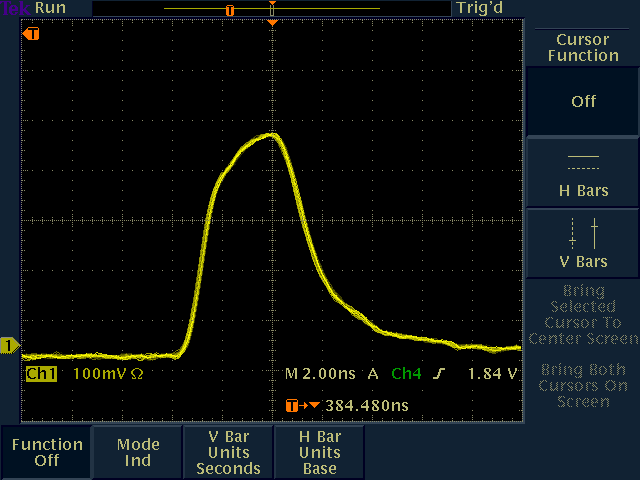
Hit the electron beam with a gigantic transversal electric field, and hope you can control it afterwards. You will need at least two axes for control, in the x direction, and the y direction.
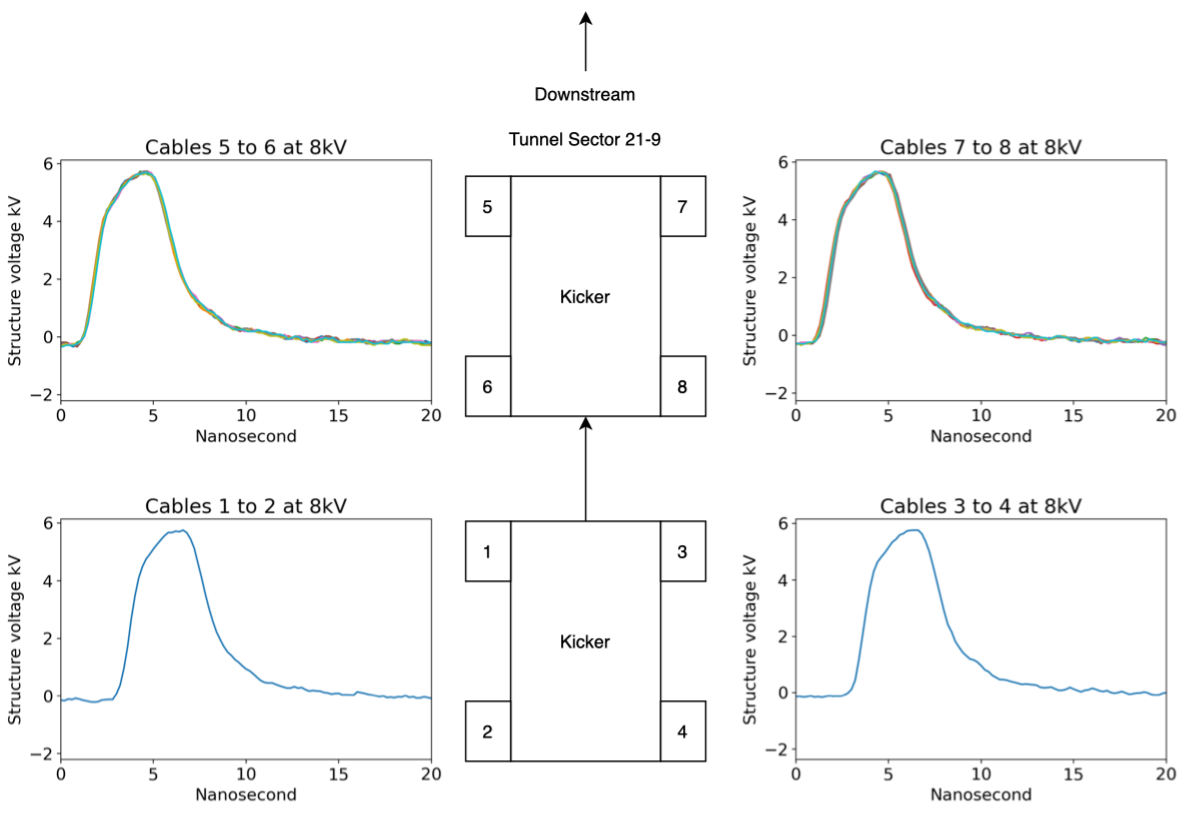
At that point in time there were a significant number of unknowns. We needed a tool to experiment with kicking the beam in different trajectories with as many degrees of freedom as possible. I developed a simple interface to kick the electron beams in different directions. This culminated in a fantastic experiment which was able to produce four bunches of closely spaced electrons, each of which lased into x-rays, who then struck a target that emulated an ablater and void for the study of inertial confinement fusion (ICF).

These kicks were extremely powerful as well as precise. These are pulses of around 1000 Volts to the electron beamline, synchronized at 1.4 GHz, with a risetime of only a few hundred picoseconds. These kicks were also necessary, for without them, the bunches would not lase into x-rays at all.